
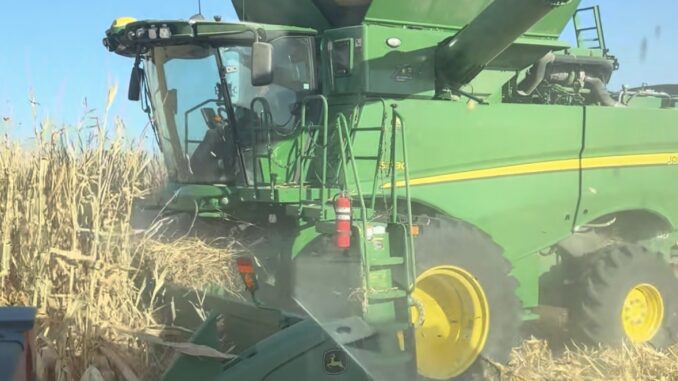
North Platte, Neb. — The combines are getting ready to roll across the Midwest, but this fall there is another number farmers may be watching almost as closely as yield: the price on the diesel tank.
Diesel prices are approaching $6 a gallon across much of farm country just as producers enter one of the most fuel-intensive stretches of the year.
The U.S. Energy Information Administration reported Midwest on-highway diesel averaged $5.946 per gallon for the week ending Sept. 7. In Nebraska, AAA reported an average of $5.928 per gallon Sunday, compared with $3.419 at the same time last year.
That is an increase of more than $2.50 per gallon in a year.
For a producer filling a 1,000-gallon tank, that difference alone represents roughly **$2,500 in additional cost** compared with last fall.
And harvest doesn’t stop with the combine.
Diesel is going into combines, tractors, grain carts and trucks hauling grain from the field. Fall tillage and fertilizer application will add additional fuel demand after the crop is out.
The higher cost is also showing up for producers who hire some of that work done.
The University of Nebraska-Lincoln’s 2026 Nebraska Agricultural Custom Rates Survey found custom farming charges generally increased from 2024 levels. Average harvest charges increased between 6% and 11%, depending on the crop.
The statewide average custom harvest charge reached $50.70 per acre for irrigated corn and $50.87 for soybeans.
UNL says those custom rates generally include machinery, fuel and labor. That distinction is important when reports of harvest costs approaching $90 an hour begin circulating. It doesn’t necessarily mean a hired hand is receiving a $90 hourly wage. Rather, the total cost of putting another operator and another piece of diesel-powered equipment in the field can quickly reach those levels or higher.
Fuel is only one piece of that equation, but this year it is a much bigger piece.
Farmers were already dealing with tight margins before harvest. Machinery costs, repairs, interest, fertilizer and labor have all put pressure on the expense side of the ledger. Higher diesel prices now arrive at a time when producers have little choice about whether to use it.
Harvest has to happen.
The diesel increase isn’t confined to the farm, either. Higher fuel costs follow the crop after it leaves the field. Rail fuel surcharges on grain shipments have climbed sharply this year, adding another transportation cost that can eventually be reflected in local basis and the price producers receive for their grain.
For some farmers, the question this fall may not be how to avoid the higher fuel bill, but how much of it can be delayed.
An Iowa producer recently told KCCI that filling his empty 5,000-gallon diesel tank at more than $5 per gallon would cost roughly $25,000, nearly twice what he paid last year. Instead of filling the tank, he said he may purchase only enough fuel to make it through harvest.
It is another example of the cash-flow decisions being made across farm country in 2026.
A few dollars per gallon may not sound enormous when compared with the price of a combine or the value of an entire crop. Multiply it by hundreds or thousands of gallons, however, and diesel becomes another significant line item taken directly out of the producer’s bottom line.
And unlike some inputs that can be reduced or postponed, when the corn is ready and the weather window opens, the combine has to roll.
This year, every hour it does will cost more.