
By Gigi Wood / Successful Farming
Early March storms improved conditions in Iowa and Illinois, while Nebraska and Texas remain vulnerable as planting season approaches.
Corn-producing states saw pockets of improvement in drought conditions from early March precipitation, but as growers look to begin another growing season, soil moisture conditions remain precarious.
While parts of the eastern Corn Belt benefited from recent storms, conditions deteriorate moving west, where farms remain vulnerable.
U.S. Drought Monitor
The latest report from the U.S. Drought Monitor shows much of the Midwest received 1–3 inches of precipitation in early March. Drought conditions improved in parts of the Ohio and Mississippi valleys to the Appalachians and parts of the Northeast.
While the rainfall helped, portions of the Great Plains and Southeast remain in severe to extreme drought. Low snowpack in the West is a concern. According to the U.S. Drought Monitor, snow water equivalent for the Colorado river basins is running 70% below the 1991–2020 average. Meanwhile, Illinois saw some of the most positive changes among corn-producing states. Illinois’ Drought Severity and Coverage Index went from 241 to 197, a 44-point improvement. But conditions shift dramatically west of the Missouri River.
Nebraska
Drought conditions in Nebraska have slightly worsened in March. About 96% of Nebraska remains in drought, with just under 4% drought free for the seven-day period ending March 10. Nearly 9% of the state moved from extreme drought to exceptional drought, worsening from slightly over 5% the week before. The overall Drought Severity and Coverage Index increased from 231 to 235.
Eric Hunt, extension educator in agricultural meteorology and climate resilience at the University of Nebraska–Lincoln, said drought conditions have been a mixed bag across the state and that overall, prospects are bleak. Southeast Nebraska will likely be fine this year, he said, if it receives a bit more rain in the coming month. Other areas are not as fortunate.
“There’s other parts of Eastern Nebraska that, especially those places that got decent rain late last week, could be OK as long as we aren’t as dry as 2023,” he said, “but there’s a lot of central and western Nebraska that can’t afford a spring to be really dry. As for the Panhandle and parts of southwest Nebraska, I would almost classify this as a dire situation for them.”
The rapid deterioration has surprised even seasoned climatologists. In October, almost none of the state was experiencing drought.
“We’ve really never seen an increase like that in the cold season before,” Hunt said.
Compounding already dry soils, low snowpack in the Colorado Rockies is exacerbating the problem.
“The snowpack levels in the Rockies, they’re basically about the lowest on record, and the prognosis for big snows is not great there,” he said.
Parts of western Nebraska may see the worst drought conditions since the early 2000s, he added.
“Meaningful drought relief would require well-above-average precipitation over the next 30–45 days, and there is currently no strong signal that such a pattern is coming,” Hunt said.
Incremental rain is possible and could help farmers in the growing season.
Additionally, rangeland and cool-season grasses are at significant risk, which could further stress already reduced cattle herds. Wheat in southwest Nebraska still has some yield potential if spring moisture improves, as it was planted with decent moisture last fall.
Iowa Had Its 20th-Driest Winter on Record. Here’s What That Means for This Year’s Crop
March rain and snow bring relief across Iowa, but uneven dryness and uncertain spring weather keep farmers watching soil conditions closely.
Drought conditions are easing across Iowa after a dry winter, with incoming moisture expected to bring additional relief.
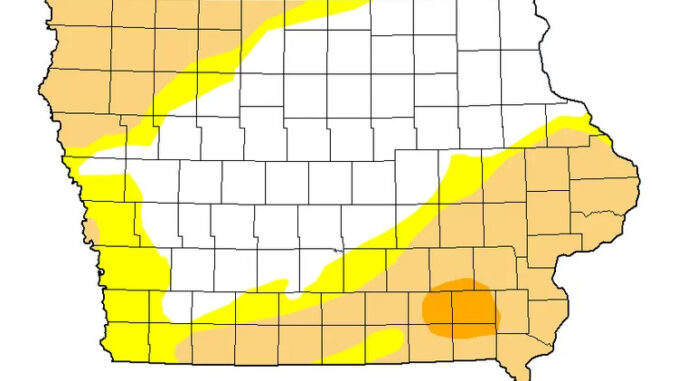
“Abnormal dryness (D0) and drought (D1–D2) have expanded across Iowa following the 10th driest February and 20th driest meteorological winter (December–February) in 154 years of records,” said Justin Glisan, Iowa’s state climatologist.
The nation’s top corn-producing state is driest in the northwest and southeast corners of the state with a pocket of severe drought in the southeast, he said.
“Overall, 38% of the state is experiencing Moderate Drought (D1), with 2% classified as D2,” Glisan said.
“Soil moisture deficits correspond closely with current drought conditions, with the driest profiles occurring along the Iowa-Illinois and Iowa-Missouri borders; eastern to southern Iowa and a pocket of northwest Iowa,” Glisan said.
March precipitation recharged soil profiles.
“Much of central Iowa currently has near-normal soil moisture, while slightly drier conditions persist from north-central to northeastern Iowa,” he said.
Too Soon to Gauge Planting Conditions
As farmers look ahead to planting, it’s too soon to say whether there is enough moisture in the soil to germinate seeds.
“Of course, some concern remains regarding the drier portions of the state; nevertheless, several weeks remain before widespread planting begins,” Glisan said. “Farmers typically delay planting when soils are saturated or excessively cold. In general, farmers prefer planting in near-normal to slightly drier soil conditions. Wetter-to-saturated soils can lead to muddy field conditions, resulting in planter issues, soil compaction, and other field management challenges.”
Some dryness would be welcome, he added.
“Shallow dryness in the upper soil profile can encourage deeper root development in corn and soybeans, which may benefit crops later in the growing season,” he said.
Outlook
Weather experts are paying close attention to drought data as the growing season nears.
“Model guidance and current conditions are being closely monitored for indications of rapid-onset drought or very wet conditions associated with a more active weather pattern heading into the early growing season,” Glisan said.
Whether the warmer seasons will be drier or wetter remains to be seen.
READ REST OF ARTICLE FROM SUCCESSFUL FARMING HERE ,