
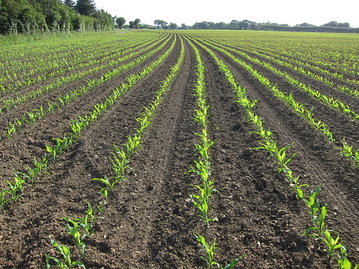
WASHINGTON, D.C. — Corn and soybean crops across much of the Upper Midwest continue to show strong early-season conditions, while drought concerns remain a significant issue for Nebraska and parts of the western Plains, according to the latest USDA Crop Progress and Condition Report released Monday.
Corn planting is essentially complete across the region. Nebraska reached 100% planted, while Iowa stood at 98%, Minnesota 99%, North Dakota 98%, South Dakota 99%, Missouri 98%, and Kansas 92%. Corn emergence is also progressing rapidly, with most states at or above their five-year averages.
Iowa reported some of the strongest corn conditions in the nation, with 84% rated good to excellent. Minnesota followed closely at 79%, while North Dakota reported 67% good to excellent. South Dakota’s corn crop was rated 62% good to excellent, Kansas 63%, Missouri 65%, and Nebraska 58%.
Soybean planting also remains ahead of average in most states. Minnesota producers have planted 98% of their soybean crop, North Dakota 94%, South Dakota 96%, Nebraska 96%, Iowa 97%, Missouri 80%, and Kansas 82%. Emergence has accelerated with favorable temperatures across much of the Corn Belt.
Soybean conditions mirror the strength seen in corn. Iowa led the region with 80% rated good to excellent, followed by Minnesota at 77%, Kansas at 63%, South Dakota at 60%, North Dakota at 63%, Missouri at 58%, and Nebraska at 63%.
Spring wheat conditions remain favorable in northern growing areas. Minnesota’s spring wheat crop was rated 86% good to excellent, among the best in the nation. North Dakota, the country’s leading spring wheat producer, reported 61% good to excellent. South Dakota’s spring wheat was rated 52% good to excellent. Planting is nearly complete across all three states.
Winter wheat conditions continue to be a concern across parts of the Plains. Kansas reported just 14% of its crop in good condition and none in excellent condition, with 57% rated poor to very poor. Nebraska’s winter wheat crop remains under severe stress, with 82% rated poor to very poor and only 4% rated good. South Dakota reported 33% poor to very poor and 27% good. Harvest has begun in Kansas, where 5% of the crop has been cut.
Sunflower planting is advancing quickly in the Dakotas. North Dakota growers have planted 80% of intended acres, well ahead of the five-year average of 63%. South Dakota producers have planted 41% of their crop, slightly behind the state’s historical average of 48%. Kansas sunflower planting reached 47%, ahead of normal.
Pasture and range conditions remain a major concern in portions of the western Corn Belt. Nebraska reported 80% of pasture and range acreage rated poor to very poor, among the worst conditions in the country. South Dakota reported 43% poor to very poor, while North Dakota stood at 23%. Kansas reported 27% poor to very poor. Conditions were considerably better in Iowa, Missouri, and Minnesota, where a majority of pastures were rated good to excellent.
Moisture conditions continue to tell a mixed story. Nebraska reported 56% of topsoil moisture rated short to very short, while South Dakota reported 50% and Kansas 33%. In contrast, Missouri showed strong moisture supplies, with 94% of topsoil rated adequate to surplus. Iowa, Minnesota, and North Dakota also reported generally favorable moisture conditions heading into mid-June.
Nationally, corn was rated 67% good to excellent, while soybeans came in at 65% good to excellent. Winter wheat conditions remain one of the weakest major crop categories, with only 25% of the U.S. crop rated good to excellent and 46% rated poor to very poor.
The USDA will release its next Crop Progress and Condition Report on June 15.