
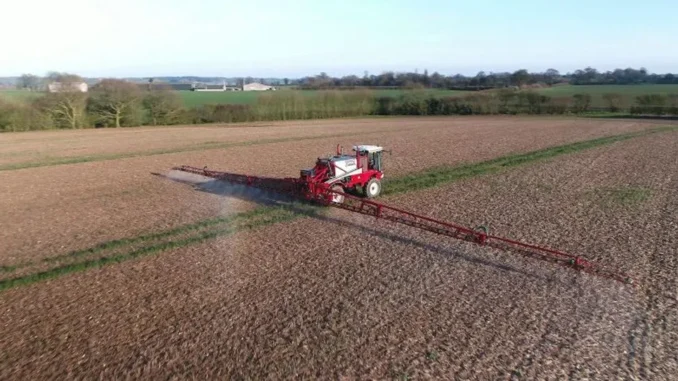
ST. PAUL, Minn. — Spring conditions across Minnesota are finally allowing soybean planting to begin in many areas. As planters start to roll, now is the time to make sure your pre-emergence (PRE) herbicide program is in place. PRE herbicides remain one of the most important, and often underutilized, tools for managing weeds and protecting soybean yield potential.
In recent years, many soybean acres across the Upper Midwest have relied heavily on POST-only herbicide programs. However, this approach is increasingly risky. The spread of herbicide-resistant weeds, including resistance to glyphosate and other commonly used POST chemistries such as ALS- and PPO-inhibitors, has made a one-pass POST strategy unreliable in many fields. With the recent confirmation of glufosinate-resistant waterhemp in Minnesota, we are now facing the very real possibility of waterhemp populations with little to no effective POST herbicide options remaining. For more information on this discovery, see the recent Minnesota Crop News article covering the first confirmed case of glufosinate-resistant waterhemp in the state.
Why PRE herbicides matter
Research across the Midwest shows that soybeans must be kept weed-free from emergence through the V3 to V4 growth stage to avoid yield loss. This period represents the critical window of weed control (Van Acker et al., 1993; Badger Crop Network, 2025). While weeds emerging after V4 may have less impact on yield, they can still produce seed and contribute to future infestations, reinforcing the importance of a “start clean, stay clean” approach.
This is especially important for waterhemp, one of the most challenging weeds in Minnesota soybean systems. Waterhemp has a prolonged emergence pattern, with new flushes continuing well into the growing season. As a result, relying solely on POST herbicides often means chasing multiple cohorts of weeds, many of which may already be too large for optimal control or may carry herbicide resistance traits.
PRE herbicides play a key role in managing waterhemp by controlling early-emerging cohorts and reducing overall weed pressure. In addition to a strong PRE foundation, layered residual programs, where an additional residual herbicide is applied POST, can extend control later into the season and help manage late-emerging waterhemp. However, if a PRE-only residual approach is used, it is critical to apply a full labeled rate and select products that provide effective, overlapping activity on key species. For more information on controlling waterhemp check out this episode of Strategic Farming: Let’s Talk Crops episode.
Several newer PRE herbicide options on the market may also offer improved weed control spectrum, particularly on small-seeded broadleaf species like waterhemp. Regardless of the approach, starting with an effective PRE program remains essential for protecting yield potential and improving overall weed management outcomes.
Key considerations for PRE programs
1. Application timing
PRE herbicides can be applied before planting, at planting, or shortly after planting, but prior to crop emergence to avoid crop injury. Applications made immediately after planting or within a few days generally provide the most consistent residual control and overall performance.
2. Activation requirements
PRE herbicides require rainfall for activation. Without sufficient moisture, control may be reduced or delayed. Given variable spring rainfall patterns in Minnesota, this is an important consideration when planning applications.
A recent North Dakota State University Crop & Pest Report addressed how long residual herbicides can remain on the soil surface before activation. Findings indicate that 0.25 to 1 inch of rainfall is typically required to activate soil-applied herbicides, and many products remain effective on the soil surface for 7 to 10 days, and in some cases up to 14 days.
In practice, the greater risk is not herbicide degradation prior to activation, but rather situations where there is enough moisture for weeds to germinate but insufficient rainfall to activate the herbicide.
3. Start clean
PRE herbicides do not control large, established weeds. If weeds are present at application, include an effective burndown herbicide or use tillage prior to planting.
4. Multiple modes of action (MOA)
Using PRE products with two or more effective MOAs broadens the spectrum of control and is a cornerstone of resistance management. This approach is especially important for managing problematic species such as waterhemp and ragweed. Research conducted in Wisconsin demonstrated that herbicide premixes containing multiple effective MOAs consistently outperformed single-MOA products, particularly for control of waterhemp and giant ragweed (Werle et al., 2026).
5. Crop safety and environmental conditions
Under cool, wet conditions, common during Minnesota springs, some PRE herbicides can cause early-season soybean injury. Products containing Group 5 (e.g., metribuzin) or Group 14 (PPO inhibitors such as flumioxazin or sulfentrazone) are more likely to cause temporary injury, particularly on coarse-textured soils with low organic matter or higher pH. For more information on how environmental conditions and soil characteristics influence preemergence herbicide performance, refer to the related Minnesota Crops News article.
Application timing is also critical, many PRE herbicides are intended for application at or shortly after planting, and applications made after soybean emergence can increase the risk of crop injury depending on the product. Always read and follow the herbicide label to ensure proper timing and minimize crop response.
Soybean typically recovers well from early-season injury, and research shows that minor visual injury rarely translates to yield loss when products are used according to label directions. In most situations, the benefits of maintaining a weed-free environment early in the season outweigh the risk of temporary crop response.
Bottom line
PRE herbicides are a foundational component of an effective soybean weed management program. As planting progresses across Minnesota, prioritizing a strong PRE program will help protect yield, improve POST performance, and support long-term resistance management. As always, consult product labels and tailor herbicide programs to your specific field conditions, soil characteristics, and weed spectrum.
As a reminder, the weekly Strategic Farming: Field Notes webinars begin on Wednesday, May 13. We’ll kick off the season with a discussion on pre-emergence herbicides. Be sure to register on the event page.
Sources
Van Acker RC, Swanton CJ, and Weise SF (1993) The critical period of weed control in soybean [Glycine max (L.) Merr.]. Weed Science. 41(2):194-200. doi:10.1017/S0043174500076050
Werle R, DeWerff RP, Arneson NJ, Smith DH, Mobli A (2026) Evaluation of single versus multiple site of action preemergence herbicides for waterhemp and giant ragweed control in Wisconsin soybean. Agrosystems, Geosciences & Environment. https://doi.org/10.1002/agg2.70290
— Eric Yu, UMN Extension Crops Educator, and David Nicolai, UMN Extension Crops Educator